Lab Diamond Engagement Ring Market: 2026 Trends
The engagement ring is the single most important product category in the diamond industry — representing roughly 40-45% of all diamond jewelry sales by value. For the past century, that category belonged entirely to natural diamonds. In 2026, that's no longer the case.
Lab grown diamonds have moved from "alternative option" to "mainstream choice" in the engagement ring market, particularly in the US. For jewelry retailers, understanding the current state of play — adoption rates, consumer preferences, pricing trends — is essential to making smart inventory decisions. This article covers the data and trends shaping the engagement ring lab grown diamond market in 2026.
Table of Contents
1. Lab Grown Market Share in Bridal
In the US, lab grown diamonds now represent an estimated 40-50% of engagement ring center stones sold by unit volume, up from roughly 20% in 2022 and under 5% in 2019. By value share, lab grown is lower — roughly 25-30% — because lab grown stones sell at lower per-carat and per-stone prices than their natural equivalents.
Several factors have driven this rapid adoption:
- Major retail chains adding lab grown lines. When Signet (Kay, Jared, Zales) and other large chains began stocking lab grown diamonds prominently, it signaled to consumers that lab grown is a legitimate, mainstream choice — not a niche alternative.
- Price gap widening. The wholesale price gap between lab grown and natural diamonds of equivalent quality has continued to widen, making the size-for-budget argument increasingly compelling.
- Peer influence. As more engagement rings feature lab grown center stones, social proof has accelerated. A bride whose friend has a 2.00ct lab grown diamond is more likely to consider one herself.
- Information availability. Consumer education content — YouTube reviews, Reddit threads, jeweler blogs — has made the lab vs natural comparison transparent and data-driven rather than mysterious and salesperson-dependent.
2. Center Stone Preferences: What Couples Are Choosing
Carat Weight
The typical lab grown engagement ring center stone has shifted upward. In 2019, a 0.70-1.00ct center stone was typical for a middle-market engagement ring. In 2026, 1.00-1.50ct is the new standard, with 1.50-2.00ct increasingly common. The budget that once bought a 0.70ct natural diamond now buys a 1.50ct lab grown diamond of equal or better quality — and couples are choosing the larger stone.
Shape Preference
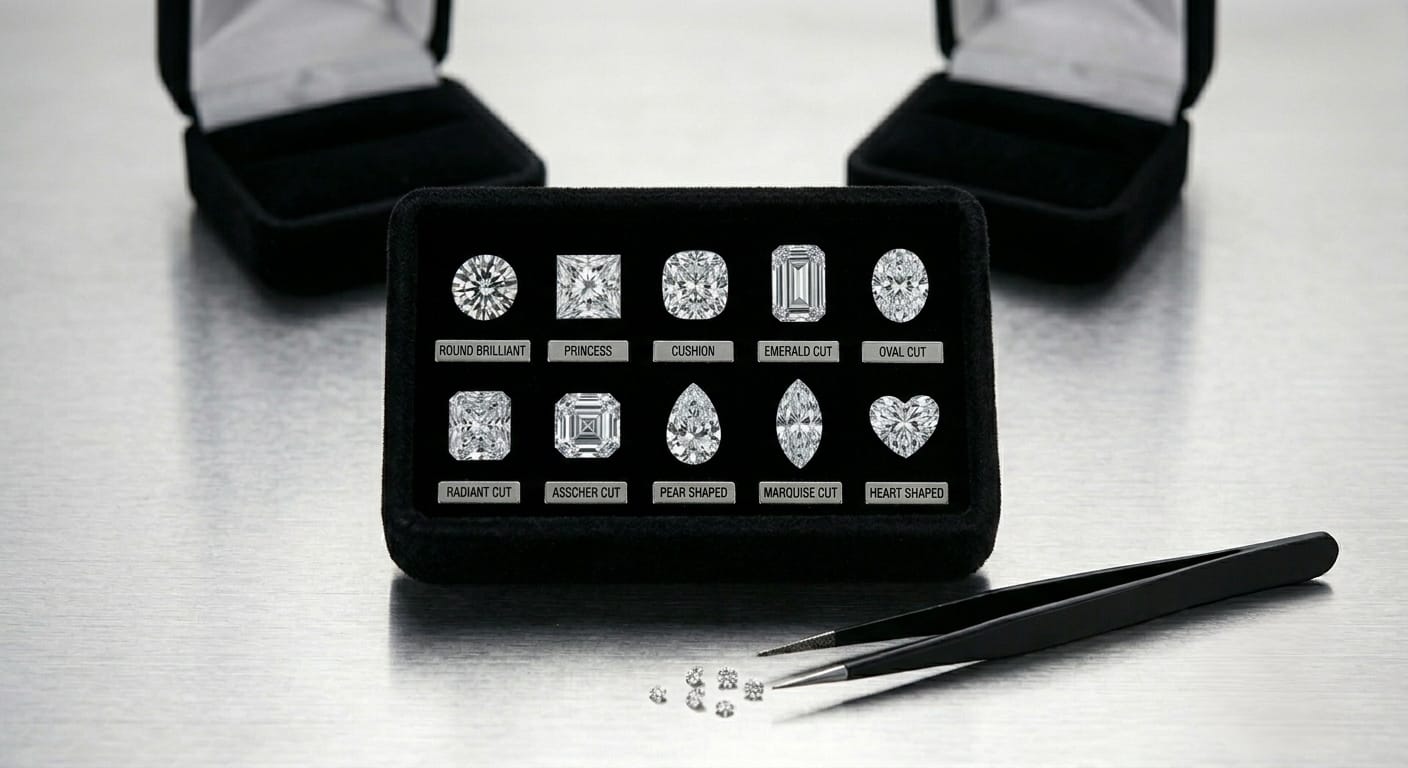
Round brilliants still lead at roughly 55-60% of lab grown engagement ring center stones. But fancy shapes are gaining faster in lab grown than in natural. Oval and cushion together account for roughly 25% of lab grown center stones — significantly higher than their share in natural — because these shapes are highly visible on social media and lab grown makes larger fancy shapes accessible.
Color and Clarity
Lab grown engagement ring buyers consistently choose D-F color and VS+ clarity. Because lab grown diamonds naturally achieve high color and clarity grades, and the price premium for D-F over G-H is smaller in lab grown than in natural, most buyers opt for the top grades. Retailers stocking G-H or SI clarity as their primary range are leaving money on the table — the small wholesale savings on lower grades don't justify the weaker sales proposition.
3. How Lab Grown Is Changing Engagement Ring Price Points
The biggest structural change lab grown diamonds have brought to the engagement ring market is collapsing the price of size. A 2.00ct D-F VS1 round brilliant that would cost $15,000-$25,000 as a natural diamond might cost $1,500-$3,000 as a lab grown diamond at wholesale. The retail price still carries a healthy margin, but the absolute dollar amount is far lower.
This is reshaping consumer behavior in two ways:
- Upgrading carat, not downgrading budget. Most couples are not spending less on the engagement ring overall — they are allocating the same budget to a larger, higher-quality stone. The jeweler maintains or grows the total sale while delivering a significantly bigger diamond.
- Budget freed for setting and side stones. With less budget absorbed by the center stone, couples are spending more on the setting — designer mountings, diamond side stones, custom design work. The center stone becomes the anchor for a higher-total-value sale.
4. What This Means for Jewelry Retailers
Don't Fight the Trend
A jeweler who refuses to stock lab grown diamonds in 2026 is losing customers who will simply walk out and buy from a competitor who does. The question is no longer "should I stock lab grown?" — it is "what is the right mix of lab grown vs natural in my showcase?" For most independent jewelers, the answer is a 40-60% lab grown center stone mix, with the ratio higher for younger customer demographics and lower for older, more traditional clientele.
Differentiate Beyond the Stone
When every jeweler can access the same lab grown diamond supply, the stone itself is not the differentiator. Your competitive advantage shifts to: curation (which stones you choose to show), setting design (custom and semi-custom mountings), and the in-store experience (education, trust, service). The retailers winning in 2026 are the ones who sell the ring, not just the diamond.
Train Your Staff Differently
Sales associates trained to sell natural diamonds by emphasizing rarity and investment value need retraining for lab grown. The effective lab grown sales conversation focuses on: the technology (how it's made), the quality (Type IIa purity, top color/clarity), and the value (what the customer gets for their budget). It is a fundamentally different narrative, and staff who conflate the two will confuse customers and lose sales.