Diamond Shape Guide for Retail Inventory Planning
Every jewelry retailer knows the anxiety of a showcase with the wrong mix. Too many round brilliants and you miss the customer who wants something unique. Too many fancy shapes and your most popular sizes sit unsold while customers ask for rounds. Getting your diamond shape inventory mix right directly affects your turnover rate, cash flow, and margin per square foot of showcase.
This guide breaks down what each diamond shape means for your inventory decisions — which shapes drive volume, which deliver margin, and how to allocate your buying budget across shapes for a balanced, sellable stock of lab grown polished diamonds.
Table of Contents
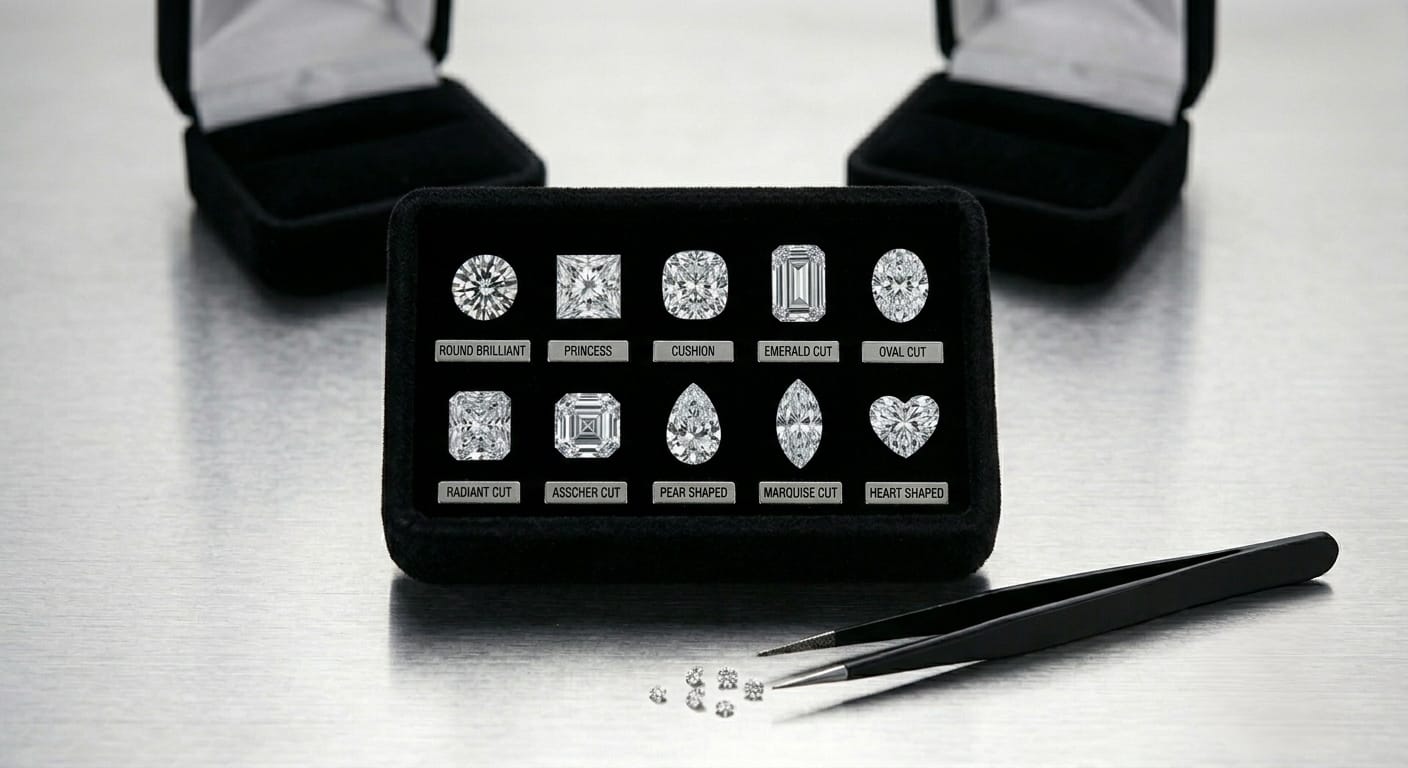
1. The 10 Standard Diamond Shapes at a Glance
Diamond shapes fall into two broad categories that affect how you buy and sell them:
| Shape | Facets | Market Position | Inventory Role |
|---|---|---|---|
| Round Brilliant | 57-58 | 70%+ of all diamond sales | Volume driver — your bread and butter |
| Princess | 57-76 | Top fancy shape, ~5-8% of market | Good volume, higher margin than round |
| Cushion | 58-64 | Growing fast, vintage appeal | Margin driver — popular for engagement rings |
| Oval | 57-58 | Top 3 fancy shape, strong bridal | Premium margin, high perceived size |
| Emerald | 50-58 | Niche but loyal, sophisticated buyer | Differentiator — attracts design-conscious customers |
| Radiant | 70 | Growing, combines brilliance + shape | Upsell alternative to princess |
| Pear | 58 | Steady niche, ~2-3% of market | Special occasion — pendants, drops |
| Marquise | 57 | Small but dedicated following | Statement piece — high carat face-up |
| Asscher | 50-58 | Small niche, Art Deco appeal | Premium differentiator |
| Heart | 57 | Occasional, sentimental purchase | Seasonal — Valentine's, anniversary |
2. Shape Demand by Market: What Actually Sells
Shape preferences vary significantly by region and customer segment. Stocking the same mix for every market is a common and costly mistake.
North America
Round brilliants dominate at roughly 55-60% of engagement ring center stones. Oval and cushion have surged over the past 3 years, together accounting for about 20% of the bridal market. Princess remains steady at 8-10%. Emerald and radiant are growing among design-conscious buyers in major metro markets. For a typical US jewelry store, a core inventory of rounds (60%), cushions (15%), ovals (10%), and princess cuts (8%) covers ~93% of customer requests.
Europe
Round brilliants are even more dominant at 65-70%. Cushion and oval are trending upward but at slower adoption rates than the US. Emerald and Asscher cuts have stronger presence in European markets with heritage jewelry traditions (UK, France, Italy). Fancy yellow shapes perform better in Europe than in the US.
Middle East
Higher carat weights and fancy shapes are the norm. Pear, marquise, and radiant shapes are significantly more popular than in Western markets. Round is less dominant (45-50%). Inventory allocation should skew toward larger sizes (1.50ct+) and fancy shapes.
Asia-Pacific
Round brilliants dominate at 70%+. Smaller carat weights (0.30-0.70ct) are the volume segment. Princess and cushion are growing among younger buyers in urban markets. Heart shapes perform well for the gifting segment.
Key Takeaway
If you serve multiple markets, don't buy one universal inventory. Segment your parcels by destination market. A Middle East parcel and a US parcel should look very different in shape distribution.
3. How to Allocate Inventory Budget by Shape
An effective inventory is not an equal split. It mirrors demand but also protects you from price competition on the most commoditized shapes. Here is a practical framework for a $50,000 initial diamond inventory:
| Shape | Budget % | Allocation | Rationale |
|---|---|---|---|
| Round Brilliant | 50% | $25,000 | Highest turnover, always in demand — focus on 0.50-3.00ct D-F VS+ |
| Cushion | 15% | $7,500 | Strong margin, growing demand — stock 1.00-3.00ct |
| Oval | 12% | $6,000 | Premium pricing possible — stock 1.00-3.00ct |
| Princess | 10% | $5,000 | Steady demand, good margin — stock 0.50-3.00ct |
| Emerald | 5% | $2,500 | Design-conscious segment — stock 1.00-3.00ct |
| Radiant | 4% | $2,000 | Upsell alternative — stock 0.75-3.00ct |
| Pear / Marquise / Others | 4% | $2,000 | Complete the showcase — stock 0.50-3.00ct |
This allocation gives you 93%+ coverage of customer requests while keeping 27% of your budget in higher-margin fancy shapes. Adjust the regional split based on your market (see Section 2).
4. Shape and Price: What Costs More and Why
Not all shapes cost the same per carat. The price differences come from rough diamond utilization — how much of the raw crystal becomes the finished stone.
| Shape | Rough Utilization | Relative Wholesale Price (vs Round) |
|---|---|---|
| Round Brilliant | ~40-45% | 100% (benchmark) |
| Princess | ~60-70% | 85-90% — less expensive |
| Cushion | ~55-65% | 90-95% |
| Oval | ~50-55% | 90-95% |
| Emerald | ~55-65% | 85-90% |
| Radiant | ~60-70% | 85-90% |
| Pear / Marquise | ~45-55% | 90-100% |
| Heart | ~40-45% | 100-110% — more expensive |
The higher the rough utilization, the lower the wholesale cost per carat. Princess, radiant, and emerald cuts use rough more efficiently — which means you can stock larger-looking stones at the same budget. This is a real margin opportunity: a 1.50ct princess cut at 85-90% of round cost gives your customer a bigger face-up size for less money.
5. The Lab Grown Advantage for Fancy Shapes
In natural diamonds, fancy shapes over 1.00 carat with high color and clarity are scarce — rough suitable for large fancy cuts is rarely allocated to anything but rounds due to market economics. The result: natural fancy shapes above 1.00ct in D-F color and VS+ clarity are genuinely hard to find and carry steep premiums.
Lab grown diamonds change this equation entirely. Because the growth process can be controlled for crystal size and quality, lab grown fancy shapes in D-F color and VS+ clarity are consistently available — including in the 1.50-3.00ct range that natural markets struggle to supply. For a jewelry retailer, this means:
- Consistent availability — oval, cushion, radiant shapes in top grades can be ordered and restocked reliably, no more waiting months for the right stone
- Better margin structure — wholesale-to-retail margins on lab grown fancy shapes are typically 10-15 points better than on natural fancy shapes, because supply is more predictable and carrying costs are lower
- Showcase differentiation — while every competitor stocks round brilliants, a showcase with high-quality lab grown ovals, cushions, and emeralds in larger sizes is genuinely distinctive
The retailers we work with who build their showcase around a strong fancy shape selection — rather than rounds alone — report faster inventory turns on those shapes and higher average transaction values.