IGI vs GIA Diamond Certificates: A Wholesale Buyer's Guide
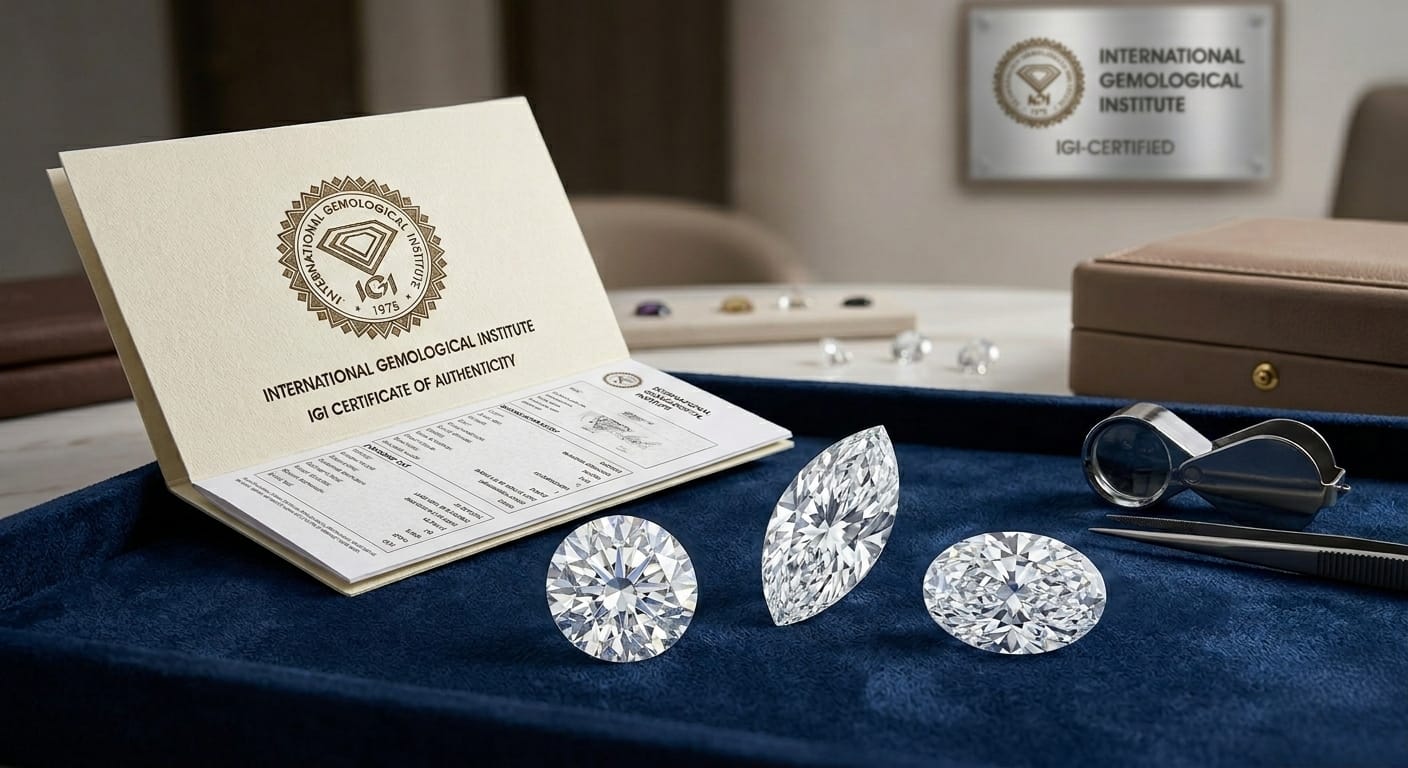
Every lab grown diamond you buy for your inventory comes with a grading report — but not all reports are created equal. The laboratory behind the certificate affects wholesale pricing, retail customer perception, and even your return rate. Understanding the differences between IGI and GIA certification for lab grown diamonds is one of the most practical things a buyer can learn.
This guide breaks down what each laboratory offers, how their grading standards compare, what the price difference means for your margins, and how to decide which certification to stock for your specific market.
Table of Contents
- 1. The Certification Landscape for Lab Grown Diamonds
- 2. IGI: The Lab Grown Diamond Standard
- 3. GIA: The Gold Standard Enters Lab Grown
- 4. Head-to-Head: IGI vs GIA Grading Comparison
- 5. Certification Cost Impact on Wholesale Pricing
- 6. What Your Retail Customers Actually Care About
- 7. Which Certificate Should You Choose?
1. The Certification Landscape for Lab Grown Diamonds
Three laboratories dominate lab grown diamond certification globally:
| Laboratory | Founded | Lab Grown Market Share | Recognition Level |
|---|---|---|---|
| IGI (International Gemological Institute) | 1975, Antwerp | ~90% of lab grown diamonds | Global — dominant in Asia, Europe, and growing in US |
| GIA (Gemological Institute of America) | 1931, California | ~8% of lab grown diamonds | Global gold standard — strongest in North America |
| NGIC (National Gemstone Identification Center) | 1995, China | ~2% (mostly domestic China) | Regional — China and some Asian markets |
IGI's dominance in lab grown is no accident. While GIA hesitated on lab grown diamond grading for years (initially issuing only "Diamond Origin Reports" without full 4Cs grades), IGI embraced the category early and built the infrastructure to grade lab grown diamonds at scale. For buyers today, IGI is the default — but GIA's entry into full lab grown grading is changing the competitive landscape.
2. IGI: The Lab Grown Diamond Standard
IGI grades over 90% of the world's lab grown diamonds. For wholesale buyers, understanding IGI's grading approach is essential:
What an IGI Report Includes
- Full 4Cs grading — Carat weight (to 0.001ct), Color (D-Z scale), Clarity (FL-I3), Cut (Excellent to Poor for rounds)
- Growth method identification — CVD or HPHT, explicitly stated
- Post-growth treatment disclosure — Whether the stone underwent HPHT treatment (standard for CVD color improvement)
- Proportions diagram — Table %, depth %, crown/pavilion angles, girdle thickness
- Clarity plot — Map of inclusion locations and types
- Laser inscription — Report number and "LAB GROWN" inscribed on the girdle
IGI Grading Consistency
IGI uses the same 4Cs grading scales as GIA but is sometimes perceived as slightly more lenient — particularly on color grading. In our experience handling IGI- and GIA-graded goods in volume, an IGI "G" color might grade as "H" at GIA roughly 30-40% of the time. This is not a flaw in IGI's system — it's a reflection of the inherent subjectivity in color grading and IGI's practical, market-oriented approach.
What This Means for B2B Buyers
When buying IGI-graded stones, mentally add half a color grade of conservatism if your customers are likely to get a second opinion. An IGI "F" is very likely a true F. An IGI "G" might be closer to G-H borderline. This is a manageable risk, not a reason to avoid IGI — just price accordingly.
3. GIA: The Gold Standard Enters Lab Grown
GIA's relationship with lab grown diamonds has evolved significantly. For years, GIA only offered "Laboratory-Grown Diamond Reports" that provided identification and basic color/clarity ranges — not the full 4Cs grades that GIA is famous for. In 2020, GIA began issuing full Laboratory-Grown Diamond Grading Reports with the same 4Cs detail as its natural diamond reports.
Key points about GIA's lab grown reports:
- Stricter grading reputation. GIA's color and clarity grading is widely considered the most conservative in the industry. A GIA "G" is definitively a G.
- Full 4Cs. Same format as GIA natural diamond reports, making cross-comparison easy for retailers who sell both.
- Higher cost. GIA reports cost 3-5x more than IGI reports, which directly impacts wholesale pricing.
- Longer turnaround. GIA's lab grown grading capacity is smaller than IGI's, leading to longer grading queues — typically 2-3 weeks vs IGI's 1-2 weeks.
- Brand recognition. In North America, GIA is the most recognized and trusted gemological laboratory by a wide margin. Consumer surveys consistently show GIA as the "most trusted" diamond grading authority.
4. Head-to-Head: IGI vs GIA Grading Comparison
Here's a practical comparison based on our experience submitting and verifying thousands of lab grown diamonds through both laboratories:
| Grading Aspect | IGI | GIA |
|---|---|---|
| Color grading strictness | Standard — slight tendency toward leniency (0.5 grade) | Conservative — considered the strictest benchmark |
| Clarity grading strictness | Standard — comparable to GIA for VS and above | Conservative — more likely to note subtle inclusions |
| Cut grading (rounds) | Excellent / Very Good / Good scale | Excellent / Very Good / Good scale (proprietary cut grading system) |
| Growth method identification | Explicit: "CVD" or "HPHT" | Explicit: "CVD" or "HPHT" |
| Treatment disclosure | Clear disclosure of post-growth treatment | Clear disclosure of post-growth treatment |
| Report turnaround | 5-10 business days | 10-15 business days |
| Digital verification | Online report check + QR code | Online report check + GIA app |
5. Certification Cost Impact on Wholesale Pricing
The choice between IGI and GIA certification isn't just about the report fee — it affects the entire pricing chain:
- Direct report cost: IGI charges $30-80 per stone (depending on size and lab location). GIA charges $35-120. For a 100-stone order, that's $1,000-2,500 vs $3,500-12,000 in certification costs alone.
- Market premium: GIA-certified lab grown diamonds command a 5-8% wholesale premium over equivalent IGI-certified stones. Whether this premium translates to your retail pricing depends on your market.
- Time cost: GIA's longer turnaround means slower inventory turnover. For a buyer holding inventory, an extra week in the certification queue is real working capital cost.
Bottom line: For most buyers, IGI certification provides the optimal balance of cost, speed, and market acceptance. The extra cost of GIA certification is justified only when your retail customers specifically ask for it — which, outside of North America, is still relatively uncommon for lab grown diamonds.
6. What Your Retail Customers Actually Care About
Here's what retail diamond buyers care about, based on consumer research and feedback from our wholesale customers:
- "Is it a real diamond?" — This is the #1 question. The certificate answers it definitively: "LAB GROWN DIAMOND" with full chemical and physical properties confirmed. Both IGI and GIA reports answer this equally well.
- "Is the quality as described?" — The 4Cs grading, proportions, and clarity plot. Both labs provide this. GIA's stricter grading gives consumers slightly more confidence, but IGI's grading is perfectly adequate for the vast majority of retail buyers.
- "Can I verify it?" — Online report verification. Both labs offer instant online verification. GIA's brand recognition gives their verification slightly more perceived weight.
- "Is it worth the price?" — This is where the certificate matters most for B2B. A GIA certificate can help justify a higher retail price point. An IGI certificate at the same wholesale price leaves more room for your margin.
7. Which Certificate Should You Choose?
| Your Business Profile | Recommended Certificate | Reason |
|---|---|---|
| Price-sensitive retailer (budget to mid-market) | IGI | Lower cost, perfectly adequate grading, accepted in all markets |
| Premium/high-end jeweler (D-F, VVS+, 2ct+) | GIA | Brand recognition justifies premium pricing; stricter grading reduces returns |
| North American market | ~70% IGI, ~30% GIA | IGI for mainstream inventory; GIA for premium showcase pieces |
| European market | IGI | IGI (Antwerp headquarters) is well-recognized; GIA premium is harder to justify |
| Asian market | IGI (or NGIC for domestic China) | IGI is the standard; NGIC is accepted for budget segments in China |
| Online/e-commerce retailer | IGI | Cost efficiency; online buyers rely more on photos/video than certificate brand |
For a deeper understanding of how certification fits into the bigger picture of diamond quality, read: The 4Cs of Lab Grown Diamonds: A Grading Guide for B2B Buyers.