Yellow Synthetic Diamond
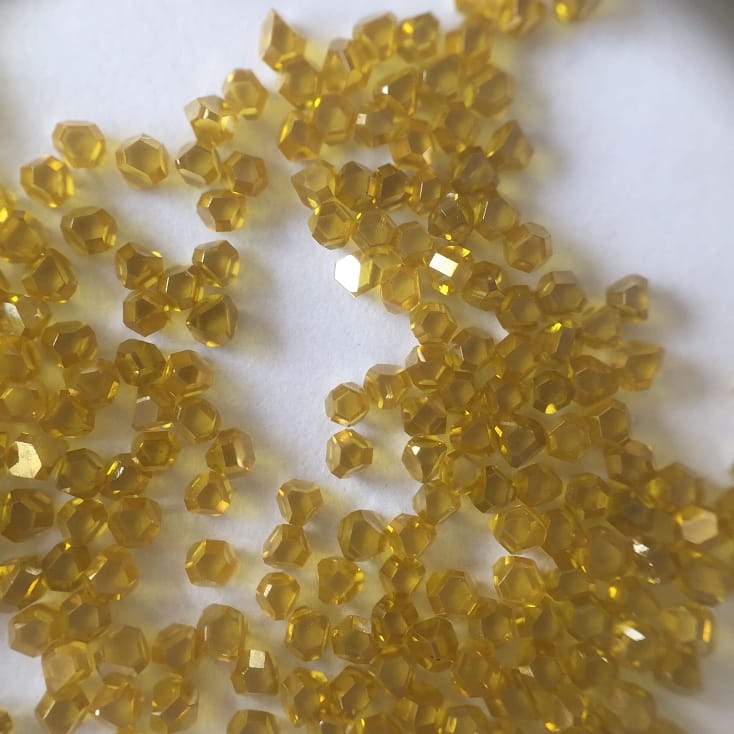
| Technology: HPHT (temperature gradient method) | Crystal Size: 1–4mm (0.05–2.0 ct/pc) |
| Color: Yellow (Type Ib, nitrogen-doped) | Crystal Form: Single crystal, cubo-octahedral |
Product Overview
Yellow synthetic diamond large single crystals are produced through the HPHT (High Pressure High Temperature) temperature gradient method — a precisely controlled growth process in which a carbon source dissolves in molten metal catalyst (typically Fe-Ni-Co alloy) and recrystallizes onto a diamond seed crystal, growing layer by layer into a complete single crystal. Each crystal is an individual, intact diamond particle, not a fragment obtained through crushing.
The yellow color originates from isolated substitutional nitrogen atoms (~100–300 ppm) dispersed within the diamond lattice — classified as Type Ib in gemological and materials science nomenclature. Unlike crushed and sieved diamond grit or micropowder, these large single crystals are individually selected and graded based on crystal integrity, morphology, clarity, and carat weight — the quality attributes that determine their performance in precision tooling applications.
Key Properties
The performance of a diamond single crystal in industrial tooling is governed by its intrinsic physical properties, which are identical to those of natural diamond:
- Extreme Hardness: Mohs 10, Knoop hardness ~70–90 GPa — the hardest known material. This is the fundamental reason diamond is irreplaceable for cutting, dressing, and wear-resistant tooling applications
- Highest Thermal Conductivity: Up to 2,000 W/m·K at 300K — roughly five times that of copper. The diamond crystal rapidly conducts heat away from the cutting or wearing point, protecting both the tool and the workpiece from thermal degradation
- High Compressive Strength: 8.7–16.5 GPa — allows the crystal to withstand the extreme contact pressures encountered in single-point cutting, indentation, and drilling without fracturing
- Low Coefficient of Thermal Expansion: ~1.0×10⁻⁶/K at 300K — minimal dimensional change ensures tool geometry stability during high-temperature operations such as dry cutting or high-speed drilling
- Low Coefficient of Friction: ~0.05–0.10 against metals — reduces cutting forces and built-up edge formation in machining, contributing to mirror-quality surface finishes
- Chemical Inertness: Resistant to all common acids and alkalis at room temperature; oxidizes in air above ~700°C, graphitizes above ~1,200°C in inert or vacuum environments
Industrial Applications
Large single crystal diamond is fundamentally different from diamond grit or micropowder — it is used where a single, intact crystal performs the cutting, dressing, or wearing function. The following are its established industrial applications:
Diamond Dressing Tools
This is the largest-volume application for industrial-grade large single crystal diamond. A selected diamond crystal (typically 0.25–2.0 carats) is mounted in a steel or carbide shank, with one sharp crystal edge or point oriented precisely to serve as the dressing element. The dresser is pressed against a rotating grinding wheel to remove dulled abrasive grains, restore the wheel's geometric profile, and re-expose fresh cutting edges — a critical maintenance operation in every grinding shop.
Dressing tool types include:
- Single-point dressers: One crystal set in a shank. Used for precision truing of conventional abrasive wheels (Al₂O₃, SiC). Crystal orientation is critical — the hardest crystallographic direction must face the wheel to maximize dresser life
- Multi-point dressers: Multiple crystals arranged in a line or cluster, providing a broader dressing contact area. Used for larger grinding wheels and higher dressing feed rates
- Blade dressers: Crystals set in a metal blade substrate. Used for heavy-duty dressing of large-diameter wheels in steel mills and foundries
- Forming dressers: A precisely shaped diamond tip used to generate complex wheel profiles for gear grinding, thread grinding, and other form-grinding operations
The key quality requirements for dressing diamonds are: intact crystal structure with no internal cracks or significant inclusions; well-developed crystal edges and points; correct crystallographic orientation for the intended dressing direction.
Geological Drill Bits & Mining Core Bits
Large single crystal diamonds (1–4mm, approximately 0.1–2.0 ct each) are set individually onto the crown of surface-set diamond drill bits. Each crystal acts as a primary cutting element that plows through rock formations during mineral exploration, geotechnical investigation, and oil/gas well drilling. The bit matrix (typically sintered tungsten carbide or bronze alloy) holds the crystals in place while allowing sufficient exposure for effective rock penetration.
Surface-set bits are particularly effective in soft to medium-hard formations (clay, shale, sandstone, limestone) where the large crystal exposure height provides high penetration rates. The quality of diamond crystals directly determines bit life: crystals with internal flaws or thermal instability will fracture or pull out prematurely, reducing the bit's effective cutting life and requiring costly tripping operations to replace the bit. Well-formed cubo-octahedral crystals with high impact strength and thermal stability are the preferred specification for this application.
Single-Point Diamond Cutting Tools (SPDT)
In ultra-precision machining, a carefully selected and oriented single crystal diamond serves as the cutting tool insert. Diamond turning tools can achieve surface roughness values below 5 nm Ra and form accuracies in the sub-micron range — performance levels unattainable with any other cutting tool material.
Primary SPDT applications include:
- Optical mold inserts for precision plastic lenses (mobile phone cameras, automotive sensors, VR/AR optics)
- Aluminum alloy mirror machining for laser reflectors and aerospace components
- Computer hard disk substrate turning
- Micro-structured surface generation (Fresnel lenses, diffraction gratings, prism arrays)
- Non-ferrous metal components for medical devices and scientific instruments
Crystals for SPDT tools require the highest quality grade: freedom from internal inclusions and cracks, correct crystallographic orientation (typically the soft direction for ease of precision lapping), and sufficient carat weight to allow for re-sharpening cycles over the tool's service life.
Wire Drawing Dies
A single diamond crystal with a precisely drilled and polished hole through its center becomes a wire drawing die — the tool through which metal wire is pulled to reduce its diameter. Diamond wire drawing dies are the standard for producing fine and ultra-fine wire from tungsten (lamp filaments), molybdenum, copper (electronic bonding wire), stainless steel (medical guidewires, suture needles), and precious metals (jewelry wire).
Diamond's combination of extreme hardness (maintains die bore geometry over millions of meters of wire), high thermal conductivity (dissipates drawing heat), and low friction (reduces drawing force and wire surface damage) makes it the definitive die material for precision wire production. Die blanks are typically cut from selected crystals of 0.1–0.5 carats, with bore diameters ranging from 0.01mm to several millimeters.
Hardness Indenters
Precision-shaped diamond crystals serve as indenter tips for Rockwell, Vickers, and Knoop hardness testing instruments. The indenter must have a precisely defined geometry — a 120° cone with a spherical tip (Rockwell), a square-based pyramid with a 136° face angle (Vickers), or an elongated rhombic-based pyramid (Knoop) — manufactured from a flawless single crystal diamond to ensure reproducible hardness measurements. These indenters are standardized consumables in quality control laboratories, materials testing facilities, and metallurgical labs worldwide.
Specialty Scientific & Industrial Applications
Beyond conventional tooling, large single crystal diamond is also used in specialized applications that exploit its unique combination of properties:
- Diamond anvil cells (DAC): Two precisely aligned diamond crystals compress microscopic samples to pressures exceeding 300 GPa — simulating conditions in planetary interiors — for materials science and geophysics research
- Heat spreaders: Large diamond platelets (cut and polished from single crystals) serve as thermal management substrates for high-power laser diodes, RF power amplifiers, and high-brightness LEDs, where heat dissipation limits device performance and reliability
- Radiation detectors: Diamond's radiation hardness and wide band gap (5.47 eV) make it suitable for alpha particle, neutron, and UV detection in nuclear monitoring, space instrumentation, and high-energy physics experiments
- Infrared optical windows: Diamond's broad optical transparency (from UV through far-IR, except for the 2.5–6 μm region affected by nitrogen absorption in Type Ib) enables its use as IR windows in harsh chemical or thermal environments
Product Specifications
| Specification | Details |
|---|---|
| Synthesis Method | HPHT temperature gradient method with metal catalyst (Fe-Ni-Co system) |
| Diamond Type | Type Ib — single substitutional nitrogen, ~100–300 ppm |
| Color | Light yellow to amber (nitrogen concentration dependent); darker crystals available for lower-cost industrial applications |
| Crystal Morphology | Cubo-octahedral (standard); octahedral and cubic forms available by controlled growth conditions |
| Crystal Size (carat weight) | 0.05–0.1 ct, 0.1–0.2 ct, 0.2–0.5 ct, 0.5–1.0 ct, 1.0–2.0 ct, 2.0 ct+ |
| Equivalent Particle Size | Approximately 1–4mm (varies with crystal morphology; approximate conversion, not a strict specification) |
| Crystal Quality Grades | Grade A: No visible inclusions or cracks under 10× magnification (SPDT, indenters); Grade B: Minor inclusions, no cracks (dressers, wire dies); Grade C: Visible inclusions acceptable, no cracks (drill bits, abrasive-grade dressers) |
| Hardness | Mohs 10; Knoop hardness ~70–90 GPa (orientation dependent) |
| Thermal Stability | Stable in air up to ~700°C; graphitization onset ~1,200°C in inert atmosphere or vacuum |
| Packaging | Individual crystals packed in labeled boxes or vials, sorted by size and quality grade. Standard quantities: 100, 500, or 1,000 carats. Custom sorting and packaging on request. |
How to Select the Right Crystal Quality
The required crystal quality grade depends on the intended application. Over-specifying quality increases cost unnecessarily; under-specifying leads to premature tool failure. The following is a practical selection framework:
| Application | Recommended Grade | Critical Quality Factors | Typical Crystal Size |
|---|---|---|---|
| SPDT cutting tools | A | Zero inclusions, correct orientation, sharp edge | 0.5–2.0 ct |
| Hardness indenters | A | Zero inclusions, flawless tip zone | 0.1–0.3 ct |
| Single-point dressers | A or B | No cracks, well-defined point, correct orientation | 0.25–2.0 ct |
| Multi-point / blade dressers | B | No cracks, multiple usable points | 0.1–0.5 ct |
| Wire drawing dies | A or B | No inclusions in die bore zone | 0.1–0.5 ct |
| Surface-set drill bits | B or C | Impact strength, thermal stability | 0.1–2.0 ct (1–4mm) |
Quality Assurance
Every crystal lot undergoes inspection to ensure conformance to the specified quality grade:
- Visual Sorting: Each crystal is individually examined under 10× optical magnification to check for inclusions, cracks, surface defects, and morphology — the primary quality gate for all grades
- Carat Weight Screening: Individual weighing on precision balances (0.001 ct resolution), sorted into specified size ranges
- Magnetic Susceptibility: Batch-level measurement of metallic inclusion content; lower values indicate higher crystal purity and better thermal stability
- Crystallographic Orientation: XRD or optical birefringence method — available for SPDT and dresser-grade crystals where orientation affects tool performance
- Thermal Stability Test: Selected samples heated to 1,000°C in inert atmosphere to verify resistance to graphitization and thermal cracking
- Impact Resistance: Drop-weight or quasi-static compression test on sample crystals to confirm mechanical integrity for drill bit and heavy dressing applications
We supply yellow synthetic diamond single crystals in standard or custom size and quality specifications. For technical grade selection assistance or to request samples for your specific tooling application, please contact us .
Frequently Asked Questions
What is the difference between large single crystal diamond and diamond grit/powder?
Large single crystal diamond is grown as an individual intact crystal via the HPHT temperature gradient method — each crystal is a complete, unbroken particle. Diamond grit and powder are produced by crushing larger crystals and sieving the fragments into size ranges. Single crystals are used where one crystal performs the entire cutting, dressing, or wearing function (dressers, SPDT tools, wire dies). Grit and powder are used where many small particles are embedded in a bond matrix (grinding wheels, saw blade segments, lapping compounds).
How do I specify the right crystal size for dressing tools?
The crystal size depends on the grinding wheel diameter and the dressing operation. For bench and cylindrical grinding wheels up to 300mm diameter, 0.25–0.5 ct is typically sufficient. For wheels 300–600mm, 0.5–1.0 ct is standard. For large centerless, roll, and surface grinding wheels above 600mm, 1.0–2.0 ct or larger crystals are specified. Multi-point dressers use smaller individual crystals (0.1–0.3 ct) since the dressing load is distributed across multiple points.
What crystal orientation should I use for SPDT tools?
For diamond turning of non-ferrous metals (aluminum, copper, brass), the crystal is typically oriented with the (110) plane as the rake face and the <100> direction as the cutting direction — this provides the best balance of wear resistance and achievable edge sharpness. For plastics and soft materials, the (100) plane rake face with <100> cutting direction is often preferred for the sharpest possible edge. The optimal orientation depends on the specific workpiece material and required surface finish. We can supply crystals with specified orientations — indicate your cutting direction requirements when ordering.
How should I store and handle diamond single crystals?
Store crystals individually in their original packaging to prevent crystal-to-crystal contact damage. Handle with clean tweezers — skin oils can contaminate the crystal surface and affect brazing or setting adhesion. Avoid thermal shock: do not transfer crystals directly from a cold storage area to a high-temperature brazing station. For SPDT-grade crystals, handle under cleanroom conditions to prevent surface contamination that would degrade cutting performance.
Can you supply crystals with specific shapes or orientations?
Yes. We can sort and supply crystals by morphology (cubo-octahedral, octahedral, cubic), by crystallographic orientation (specified by zone axis), and by targeted carat weight range. For special applications such as diamond anvil cells or custom optical elements, please provide your detailed specification and we will confirm feasibility.