How to Read an IGI Diamond Grading Report
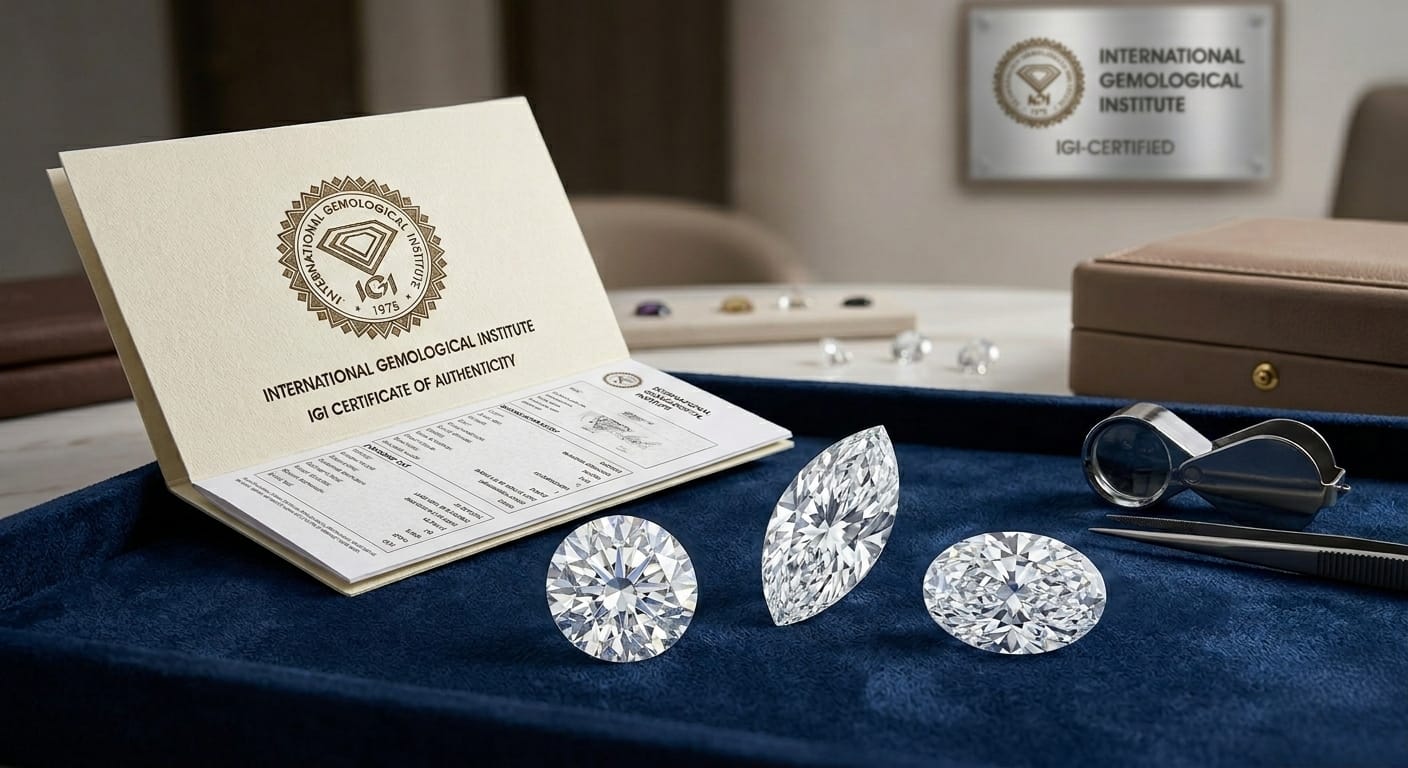
A diamond grading report is more than a piece of paper — it is the authoritative description of what you are buying. For B2B buyers, understanding every field on the report means you can verify that stones match your specifications, explain grades to customers with confidence, and catch discrepancies before they become problems.
This article walks through an IGI diamond certification report section by section, explaining what each field means and what to check as a buyer.
Table of Contents
1. Report Header: Number, Date, and Type
| Field | What It Tells You |
|---|---|
| Report Number | Unique identifier for this certificate. You can verify this number on the IGI website (igi.org/verify) to confirm the report is genuine and matches the IGI database. |
| Date | When the diamond was graded. Older dates are not a problem — a diamond graded in 2023 is the same diamond today. But extremely old dates (5+ years) on a stone being sold as "new production" might warrant a verification check. |
| Description | States "Laboratory Grown Diamond" — this is the legal designation. All IGI reports for lab grown diamonds clearly state this. |
| Shape and Cutting Style | E.g., "Round Brilliant" — confirms the shape and faceting pattern. |
2. The 4Cs Section
This is the core of the report — the carat weight, color, clarity, and cut grades that define the diamond's quality:
| Grade | What to Check |
|---|---|
| Carat Weight | Stated to 2 decimal places (e.g., 1.01 ct). Verify this matches your order spec. Small deviations (0.01-0.02ct) are normal in parcel orders — the supplier should have confirmed acceptable tolerance. |
| Color Grade | D-Z scale for colorless; Fancy Light/Fancy/Intense for colored diamonds. Lab grown diamonds typically grade D-F for colorless stones. Check that the color matches your spec — a G-H stone in what was ordered as a D-F parcel is a grading issue. |
| Clarity Grade | FL to I3 scale. Most wholesale lab grown diamonds grade VS1-VS2 or VVS1-VVS2. SI1 is the value threshold — still eye-clean in most sizes. SI2 and below should be reviewed before accepting. |
| Cut Grade | For round brilliants only: Excellent, Very Good, Good, Fair, Poor. Fancy shapes do not receive a cut grade. Always require Excellent or Very Good for rounds. |
3. Proportions Diagram
The proportions section provides the actual measurements that determine how the diamond handles light:
| Measurement | What to Check (Round Brilliant) |
|---|---|
| Table % | 54-60% is ideal. Table above 62% reduces fire; below 52% traps light. |
| Depth % | 59-62% is ideal. Above 63% makes the diamond look smaller face-up. |
| Crown Angle | 33-35 degrees. |
| Pavilion Angle | 40.6-41.0 degrees. |
| Measurements | Diameter range in mm (e.g., 6.38-6.42 x 3.95 mm). The difference between min and max diameter should be small (<0.05mm for a well-cut round). |
These numbers are shown on a diagram of the diamond's profile and crown view. If a number is far outside the ideal range, the diamond was cut for weight retention, not light performance. Avoid weight-retention cuts for retail inventory.
4. Additional Grading Information
| Field | What It Means |
|---|---|
| Polish | Surface finish quality. Excellent or Very Good is standard. Good is acceptable for budget inventory. Fair or Poor indicates visible surface defects. |
| Symmetry | How precisely the facets align. Excellent or Very Good is standard. Misaligned facets reduce light performance even if proportions are ideal. |
| Fluorescence | None, Faint, Medium, Strong, or Very Strong. None or Faint is standard for lab grown. See our fluorescence guide for details. |
| Clarity Characteristics | Describes the types of inclusions present (e.g., feather, crystal, pinpoint). The diagram on the report shows their approximate location. Most lab grown diamonds have minimal inclusions — crystal or pinpoint are the most common types. |
5. Laser Inscription and Comments
Laser Inscription: The report number is laser-inscribed on the diamond's girdle (the outer edge). This is the physical link between the stone and the certificate. You can verify the inscription with a 10x loupe. It is a key trust signal when presenting a diamond to a customer.
Comments: The comments section contains important disclosures not captured in the grades. Common comments on IGI reports for lab grown diamonds include:
- Indication of post-growth treatment (standard for CVD diamonds)
- Type IIa designation (most lab grown diamonds are Type IIa)
- Growth method (HPHT or CVD)
Always read the comments section. It is where important manufacturing disclosures live — and where an honest supplier has nothing to hide.