Fancy Color Lab Diamonds: Complete Buying Guide
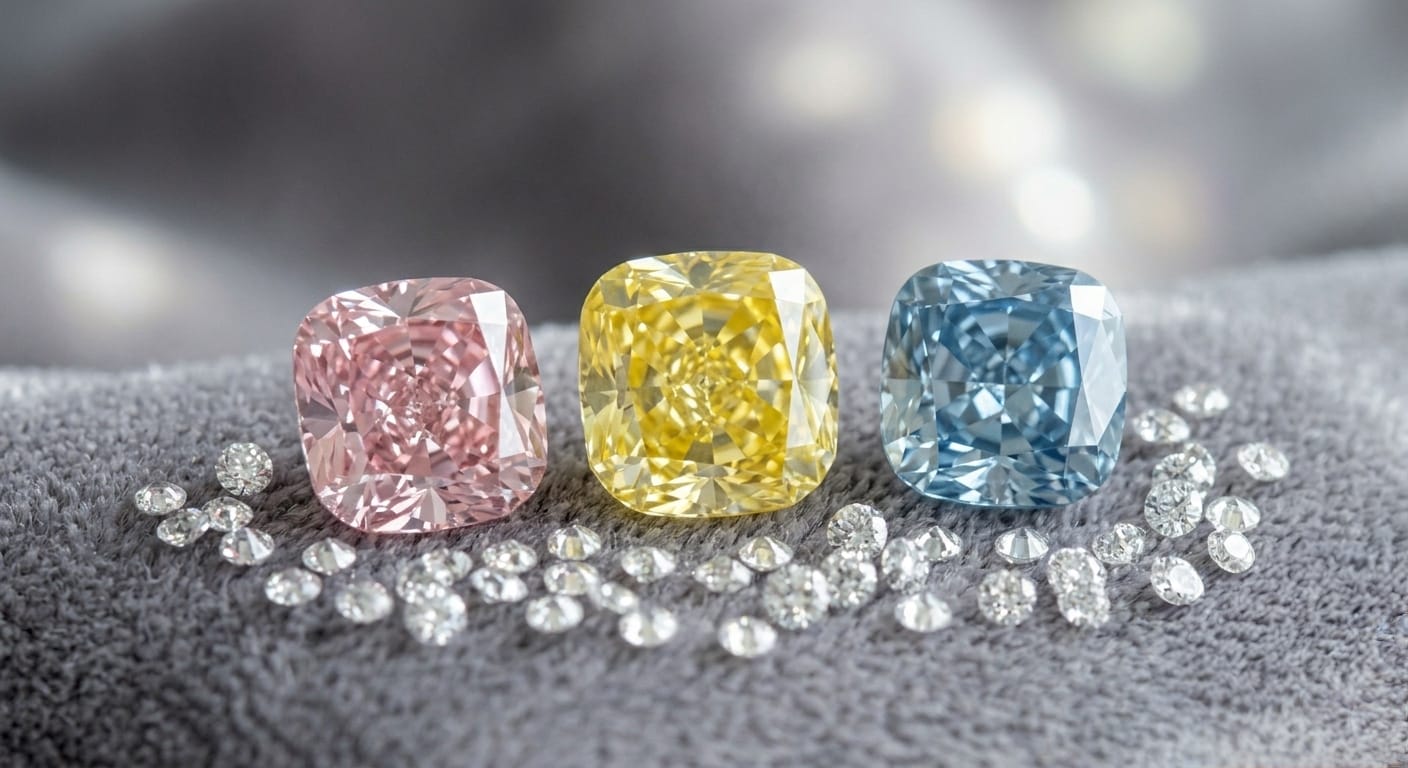
Fancy color diamonds — yellow, pink, blue, and beyond — represent one of the highest-margin segments in diamond jewelry. In natural diamonds, a vivid pink or blue stone can cost more than most retail stores' entire annual inventory. Lab grown technology changes that math entirely, making colored diamonds accessible at price points that retailers can actually sell.
This guide covers what B2B buyers need to know about sourcing fancy color lab grown diamonds: how the color is created, how grading works differently from colorless diamonds, what each color costs, and which colors are reliably available at wholesale. Browse our Fancy Color Diamond collection for yellow, pink, and blue product specifications.
Table of Contents
1. How Lab Grown Diamonds Get Their Color
In both natural and lab grown diamonds, color comes from trace elements or structural features introduced during crystal formation. The difference is that lab grown production can control these conditions — making fancy colors far more available than in nature.
| Color | Cause | Production Method | Availability |
|---|---|---|---|
| Yellow | Nitrogen atoms incorporated into the carbon lattice during growth | HPHT primarily; CVD with controlled nitrogen doping | Widely available — most common fancy color in lab grown |
| Pink | Irradiation and annealing creating nitrogen-vacancy centers | CVD followed by post-growth irradiation + heat treatment | Moderately available — growing supply as treatment technology matures |
| Blue | Boron atoms replacing carbon in the crystal lattice | HPHT with boron doping during growth | Limited availability — fewer producers, longer growth cycles |
| Green | Radiation exposure creating GR1 color centers | Post-growth irradiation of CVD or HPHT stones | Limited — mostly special order |
The key for B2B buyers: yellow is the volume play, pink is the margin play, blue is the premium differentiator. Most retailers start with yellow, then add pink as demand grows.
2. Fancy Color Grading: Different from D-Z
Fancy color diamonds use a completely different grading scale than the D-Z colorless scale. Instead of grading how little color a diamond has, fancy color grading measures the hue, tone, and saturation of the color that is present.
| Grade | Meaning | Price Impact |
|---|---|---|
| Faint | Barely perceptible color | Modest premium over colorless |
| Very Light | Noticeable but pale | Small premium |
| Light | Clearly colored, soft tone | Moderate premium |
| Fancy Light | Distinct color, medium intensity | Good value point — color is clear, premium is reasonable |
| Fancy | Rich, unambiguous color | Significant premium — 50-100% over colorless equivalent |
| Fancy Intense | Deep, saturated color | Strong premium — 100-200%+ over colorless |
| Fancy Vivid / Fancy Deep | Maximum color saturation | Highest premium — rare even in lab grown |
Practical B2B guidance: Fancy Light and Fancy grades are the sweet spot for retail. The color is clearly visible and distinct — customers immediately see the difference — but the premium over colorless is manageable. Fancy Intense and Vivid stones are beautiful but represent a small fraction of actual retail demand due to their price point.
3. Color-by-Color Buying Guide
Yellow Diamonds
Yellow is the entry point to fancy color diamonds for most retailers. Bright, warm, and immediately recognizable as "different" from colorless — yellow diamonds make a clear statement in a showcase. They pair beautifully with yellow gold settings, which is the dominant metal in many markets.
- Most popular grades: Fancy Light Yellow to Fancy Yellow
- Common sizes: 0.30ct to 3.00ct; 1.00ct is the volume sweet spot
- Best shapes: Cushion, radiant, and pear — these shapes concentrate color and maximize visible saturation
- Certification note: IGI fancy color reports include the color grade and often the origin of color (e.g., "Natural Color — Nitrogen")
Pink Diamonds
Pink lab grown diamonds carry the emotional appeal of natural pink diamonds — the world's rarest and most expensive — at a tiny fraction of the cost. For a retailer, a 1.00ct Fancy Pink lab grown diamond at wholesale might cost what a 0.01ct natural pink melee would cost.
- Most popular grades: Fancy Light Pink to Fancy Pink
- Common sizes: 0.30ct to 1.50ct; 0.50-0.70ct is the volume range because pink color shows well even in smaller stones
- Best shapes: Cushion and oval — the soft shape complements the soft color
- Quality note: Some pink lab grown diamonds show uneven color distribution (color zoning). Request stones with even color saturation, and ask to see photos or video before shipping.
Blue Diamonds
Blue lab grown diamonds are the rarest of the three main fancy colors. Boron doping during HPHT growth is technically demanding, and production volume is lower than yellow or pink. This scarcity supports stronger retail pricing.
- Most popular grades: Fancy Light Blue to Fancy Blue
- Common sizes: 0.30ct to 1.00ct; larger sizes above 1.50ct are difficult to source and require longer lead times
- Best shapes: Cushion and radiant — broader facets show blue color more evenly
- Conductivity note: Boron-doped blue diamonds are electrically conductive — this is a genuine test that distinguishes natural blue diamonds (also boron-doped) from coated imitations. A useful selling point for technically-minded customers.
4. Pricing by Color: What to Expect
Fancy color diamond pricing is less standardized than colorless because each stone's color intensity, evenness, and secondary hue affect value. However, as a general guide relative to an equivalent-size D-F colorless round brilliant:
| Color | Fancy Light | Fancy | Fancy Intense |
|---|---|---|---|
| Yellow | +10-20% | +30-50% | +60-100% |
| Pink | +30-50% | +80-150% | +150-300% |
| Blue | +40-60% | +100-200% | +200-400% |
Retail markup potential: A Fancy Yellow diamond at 30% wholesale premium over colorless can retail at 80-100% premium — fancy color customers are less price-sensitive and more focused on the emotional appeal of the color. The spread between wholesale cost and retail price is consistently wider for fancy colors than for colorless diamonds.
5. Retail Positioning: Selling Fancy Colors to Your Customers
Fancy color diamonds sell differently than colorless. The customer who buys a pink diamond is not the same customer who compares 4Cs on a spreadsheet for an engagement ring. Here is what works in practice:
- Frame it as a statement, not a spec. Don't lead with carat weight and clarity grade. Lead with the color — "This is a Fancy Yellow diamond, and the color is completely natural to the stone's crystal structure."
- Use the natural comparison honestly. A 1.00ct Fancy Pink natural diamond might auction for $1M+. A 1.00ct Fancy Pink lab grown diamond delivers the same visual impact for a tiny fraction. This is not a misleading comparison — it is the reality of the market.
- Stock at least one of each main color. Even if a customer comes in for a colorless engagement ring, seeing a yellow, pink, or blue diamond in the showcase starts a conversation. Some percentage of those conversations become sales you wouldn't have made otherwise.
- Fancy colors are not just for center stones. Yellow and pink melee in halo settings, side stones, and eternity bands add color accents that set a piece apart. Stocking colored melee multiplies the design options you can offer.