How to Build a Diamond Parcel for Your Market
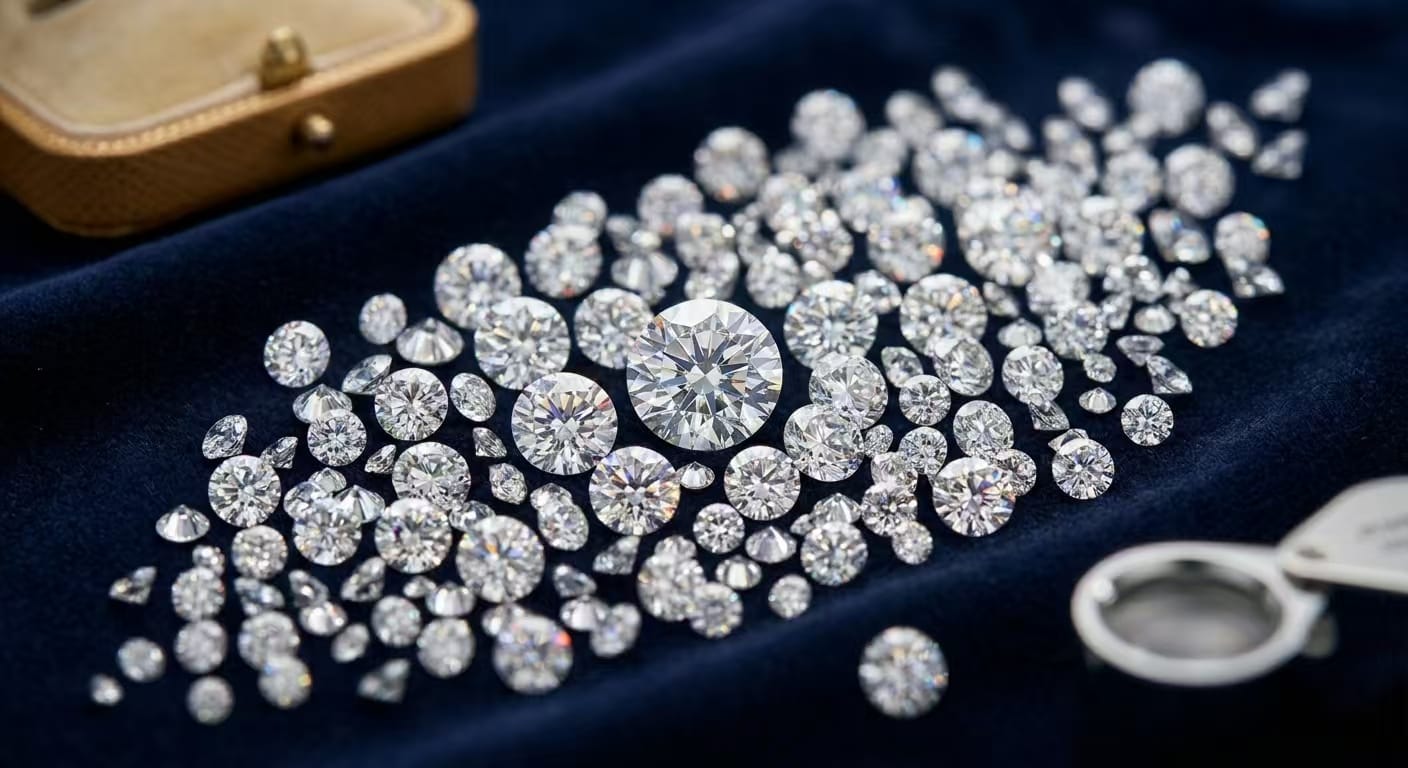
A diamond parcel is more than a box of stones. It is your working capital translated into inventory — and every stone in it either earns its place on your shelf or quietly drains your cash flow. The difference comes down to how well the parcel matches what your customers actually buy.
This guide explains how to structure a custom diamond parcel that aligns with your market position, customer preferences, and budget — and how to communicate those specs clearly to your supplier so you get exactly what you need.
Table of Contents
1. Three Types of Diamond Parcels
Before you define the spec, decide which parcel type fits your business model:
| Parcel Type | Best For | Typical Order Value | Lead Time |
|---|---|---|---|
| Standard Parcel | First-time buyers testing the market; filling common size gaps in existing stock | $2,000 - $8,000 | 5-10 days (in-stock) |
| Custom Parcel | Established retailers with known customer preferences; buyers serving specific market niches | $8,000 - $50,000+ | 7-21 days (partial sourcing) |
| Melee Parcel | Jewelry manufacturers; retailers stocking side stones and accent diamonds | $1,000 - $5,000 | 3-7 days (high-volume in-stock) |
Most buyers start with a standard or melee parcel to establish a relationship, then move to custom parcels once they know what sells.
2. Defining Your Parcel Spec: The 5 Decisions
A clear parcel spec has five components. Leave any one of them vague, and you risk getting stones that don't match what your customers want.
Decision 1: Size Range (Carat Weight Distribution)
This is the most important decision. Your carat weight range should reflect what your customers ask for most often. For most jewelry retailers, the 0.50ct - 2.00ct range covers 80-90% of engagement ring center stone requests. Here is a sample distribution for a $20,000 parcel:
| Carat Range | % of Stones | Approximate Qty | Typical Use |
|---|---|---|---|
| 0.30 - 0.49ct | 15% | 8-12 stones | Side stones, pendant center, budget engagement |
| 0.50 - 0.69ct | 20% | 10-15 stones | Entry-level engagement ring center |
| 0.70 - 0.99ct | 25% | 10-15 stones | Core engagement ring range |
| 1.00 - 1.49ct | 25% | 8-12 stones | Primary engagement ring center |
| 1.50 - 2.00ct | 10% | 4-6 stones | Premium engagement, anniversary |
| 2.00 - 3.00ct+ | 5% | 2-3 stones | Statement piece, special order |
The exact distribution depends on your market. A store in a mid-size US city might weight 1.00-1.49ct heaviest. A store in a developing market might weight 0.30-0.69ct heaviest.
Decision 2: Color Grade Mix
Lab grown diamonds naturally achieve high color grades, so D-E-F colorless is the standard. For most markets, we recommend:
- 70% D-E-F colorless — your core stock, the grades customers expect in a showcase
- 25% G-H near-colorless — price-sensitive customers who prioritize carat size over absolute color
- 5% I-J or fancy — special requests, yellow gold settings where color is less visible
Decision 3: Clarity Grade Mix
For lab grown diamonds, VS1-VS2 is the practical sweet spot — eye-clean at normal viewing distance, consistently available, and well-priced. Our recommended split:
- 40% VS1-VS2 — the workhorse grade, eye-clean, good value
- 40% VVS1-VVS2 — customers who specifically request "high clarity"
- 20% SI1 — price-sensitive segment; still eye-clean in most sizes, saves 15-25% vs VS
Decision 4: Shape Mix
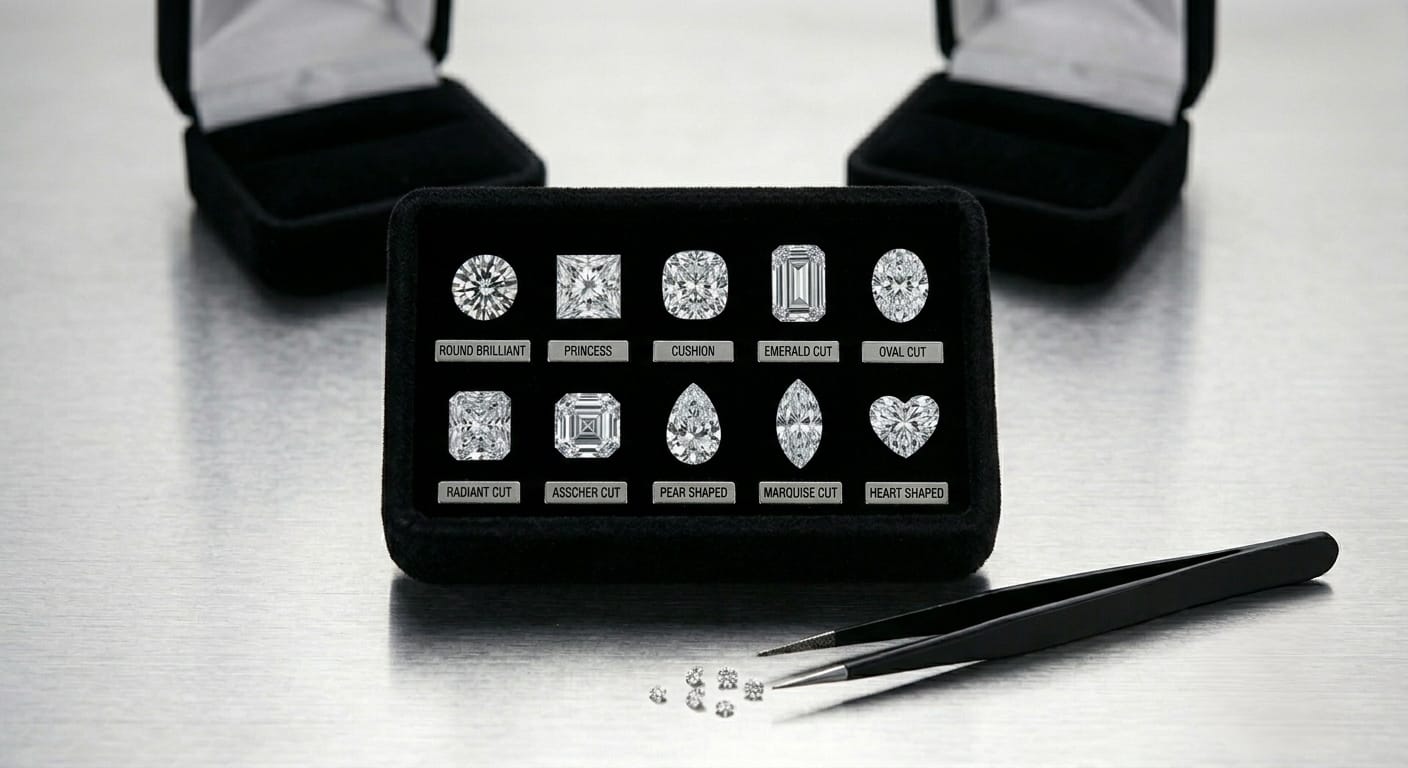
Covered in detail in our Diamond Shape Guide. The short version: rounds drive volume (50-60% of parcel), cushions and ovals drive margin (15-20% combined), princess, emerald, radiant, and others fill the rest.
Decision 5: Certification Preference
IGI certification is the standard for lab grown diamonds — over 90% of lab grown stones are IGI graded. GIA certification adds perceived value for premium markets but costs more per certificate. Specify your preference upfront — it affects both pricing and lead time.
A Good Parcel Spec Looks Like This
"50 stones, 0.50-2.00ct, D-E-F color, VS1-VS2 clarity, 60% round / 20% cushion / 10% oval / 10% princess, IGI certified." That one sentence tells the supplier everything they need to quote and assemble.
3. Budget Allocation Within a Parcel
How you split your budget across sizes affects both the number of stones you receive and how fast they sell. A common mistake is spreading the budget evenly — which leaves you with plenty of small stones and no showcase-worthy center stones. Here is a smarter approach:
| Carat Range | Budget % | Reasoning |
|---|---|---|
| 0.30 - 0.69ct | 20% | More stones, lower per-unit cost — fills the showcase affordably |
| 0.70 - 0.99ct | 25% | Good balance of size and cost — high turnover range |
| 1.00 - 1.49ct | 30% | Highest demand for engagement rings — allocate the most budget here |
| 1.50 - 2.00ct | 15% | Premium tier — fewer stones, higher margins per stone |
| 2.00ct+ | 10% | Showcase anchors — one or two impressive stones that draw customers in |
Notice that 55% of the budget goes to stones 0.70ct and above — because that is where most engagement ring center stone decisions are made.
4. How to Communicate Parcel Specs to Your Supplier
The quality of the parcel you receive is directly proportional to the clarity of the spec you send. Here is what a well-communicated parcel order includes:
- Total budget or total carat weight — the overall constraint
- Size distribution — percentage or quantity per carat range
- Color and clarity ranges — minimum acceptable grades
- Shape mix — percentage per shape, or at minimum round vs fancy split
- Certification — IGI or GIA; whether every stone is certified or only above a threshold
- Any deal-breakers — e.g., "no stones with strong fluorescence", "no I-color or below", "only Excellent/Ideal cut for rounds"
A supplier who asks clarifying questions about your spec is a good sign — it means they are thinking about whether the parcel actually works for your market, not just shipping whatever is on the shelf.
5. Four Common Parcel Ordering Mistakes
Mistake 1: Ordering Only What You Personally Like
Your personal taste is not your customer's taste. You might love emerald cuts, but your market might be 70% round. Let sales data — not preference — drive the spec.
Mistake 2: Over-Specifying on Paper, Under-Communicating in Practice
Sending a spreadsheet is good. Having a 10-minute call to explain your market and what your customers ask for is better. The supplier who understands why you need certain specs will make smarter substitutions when exact matches aren't available.
Mistake 3: Chasing the Lowest Per-Carat Price
A parcel quoted at $X/carat with loose grading tolerance and mixed makes is not cheaper than a parcel at $X+15%/carat from a consistent source. Returns, customer disappointment, and slow-moving stock are real costs. Price the quality, not just the carat.
Mistake 4: No Feedback Loop
After your first parcel sells through, tell your supplier what moved fastest, what sat, and what customers asked for that wasn't in the parcel. Each subsequent order gets more precise — but only if the supplier learns from the previous one.